Collapsed pipe: what a fix costs
A collapsed sewer pipe costs $1,500 to $5,000 to spot repair or $5,000 to $15,000 to replace. Three worked estimates with every line item shown.
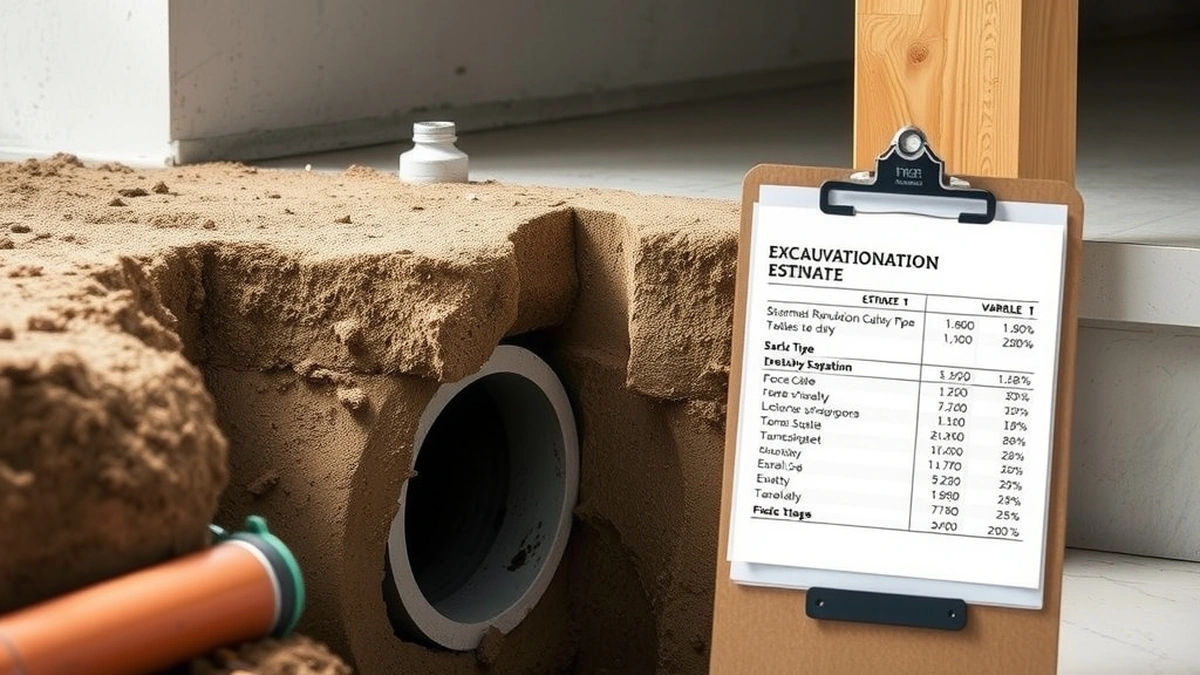
Fixing a collapsed sewer pipe costs $1,500 to $5,000 for a spot repair of the failed section, or $5,000 to $15,000 for pipe bursting or open-trench replacement. Add $200 to $500 for the camera inspection and $500 to $1,500 if sewage has already backed up.
- Spot repair
- $1,500 - $5,000
- Pipe bursting
- $5,000 - $15,000
- Open-trench replacement
- $5,000 - $15,000
- Emergency backup clear
- $500 - $1,500
Some links on this page are affiliate links.If you buy through them we may earn a commission at no extra cost to you. We do not accept payment for rankings. Read the full disclosure.
Fixing a collapsed sewer pipe costs $1,500 to $5,000 for a spot repair of the failed section, or $5,000 to $15,000 for pipe bursting or open-trench replacement. Add $200 to $500 for the camera inspection, and $500 to $1,500 if sewage has already backed into the house and needs an emergency clear. Depth and surface finish decide where in each band the job lands.
Why the range is so wide
A collapse is a construction job, not a service call. Every price includes four things that a cleaning does not:
- Excavation or access pits
- New pipe and fittings
- Bedding and compaction
- Surface restoration
A spot repair touches one of each, in one place. A replacement touches all four across the full run. That is the difference between $2,000 and $12,000, and it is not a markup — it is a different amount of work.
There is also a third cost that owners often forget: the emergency clear. If the house is backing up when you call, the first visit is $500 to $1,500 just to restore flow enough to inspect. That money is spent before any repair is quoted.
The line items
| Line item | Spot repair | Full replacement |
|---|---|---|
| Camera inspection | $200 - $500 | $200 - $500 |
| Emergency clear | $500 - $1,500 | $500 - $1,500 |
| Excavation or pits | $800 - $2,500 | $2,000 - $6,000 |
| Pipe and fittings | $150 - $600 | $600 - $1,800 |
| Bedding and compaction | $200 - $600 | $400 - $1,200 |
| Surface restoration | $0 - $3,000 | $0 - $6,000 |
| Permit | $50 - $500 | $50 - $500 |
| Post-repair camera | $0 - $300 | $0 - $300 |
Restoration is the swing item on both columns. It is also the item most often left out of a verbal quote.
Three worked estimates
Estimate one: a collapsed section under a lawn, 25 feet from the house. Camera $350, emergency clear $700, excavation of 10 feet at $1,600, pipe and fittings $350, bedding $300, sod $250, permit $100, post-repair camera bundled at $0. Total $3,650.
Estimate two: a collapse under a concrete driveway. Camera $350, clear $700, excavation of 12 feet with sawing and shoring $3,200, pipe $400, bedding $350, concrete repour $2,800, permit $150, camera $250. Total $8,200. The pipe work is $750 of that. The rest is access and surface.
Estimate three: 70 feet of Orangeburg that has collapsed in two places. Camera $400, clear $800, pipe bursting of 70 feet at $11,500, two pit restorations at $400 each = $800, permit $200, camera $300. Total $14,000. Open trench with full driveway restoration was quoted at $16,500, so bursting saved $2,500 and a week of driveway access.
Per-foot pricing, and when it misleads
- $3,650 for 10 feet of repair = $365 per foot.
- $8,200 for 12 feet = $683 per foot.
- $14,000 for 70 feet = $200 per foot.
The middle number is the highest per foot and is not the worst value. It is the same repair under a driveway in deeper ground. Per-foot pricing is only comparable between jobs with the same depth and surface.
Ask each contractor for the footage they measured on camera, and check it against the video. A quote for “approximately 40 feet” that turns out to be 28 feet is a 40 percent overrun on the pipe line.
What pushes the price up
Depth. A line at 18 inches is a hand dig. At six feet it needs shoring and possibly a vac truck, which adds $1,000 to $2,500.
Surface. Lawn restores for a few hundred dollars. Concrete, asphalt, pavers or a finished patio add $1,500 to $4,500.
Multiple failures. Two collapses on one run usually justify replacing the whole run, because a third is likely. Two spot repairs at $3,500 each is $7,000, which is close to the low end of a replacement.
Utility conflicts. A gas line, water main or electrical conduit crossing the trench adds hand digging and time.
Permits and inspections. $50 to $500 for the permit, plus an inspection that may hold the job for a day.
Emergency timing. A collapse discovered on a Friday night costs the $500 to $1,500 emergency band before any repair is scheduled.
Repair versus replace, in dollars
Take a 60-foot clay run with one collapse at 30 feet and two cracked joints elsewhere.
-
Spot repair at the collapse: $3,600.
-
Lining the remaining run after the repair: $7,500.
-
Total: $11,100, with two warranties and two mobilizations.
-
Full replacement of 60 feet with bursting: $11,000, one warranty, one mobilization.
The numbers land within $100 of each other, which is the point. Once a collapse sits in the middle of a deteriorating run, patching and replacing cost about the same. The replacement is the better purchase because it removes the next failure rather than waiting for it.
The method comparison is set out in collapsed pipe repair, and the replacement pricing is in full replacement cost. If the camera shows a sag rather than a break, the price ladder is different and bellied pipe cost is the closer guide.
How to keep the bill down
- Get the camera inspection before authorising any repair. At $200 to $500 it prevents paying for the wrong scope.
- Ask for the footage, and compare it to the video.
- Get two methods quoted — spot repair and bursting, or bursting and open trench — on the same footage.
- Add restoration to both quotes before comparing totals.
- Ask whether the permit and the post-repair camera are included, because both are commonly added later.
- Do not wait. A collapse with continued use pulls soil into the line and turns a local repair into a run replacement.
For the immediate steps when sewage is already backing up, see sewage backup repair. For prevention of the next one, collapsed pipe prevention covers the inspection interval and the soil conditions that cause failures.
Frequently asked questions
How much does it cost to fix a collapsed sewer pipe?
A spot repair of the failed section runs $1,500 to $5,000. Replacing the run with pipe bursting or open trench is $5,000 to $15,000. The camera at $200 to $500 is separate.
Why is a collapsed pipe more expensive than a blocked one?
Because it is construction, not cleaning. A blockage is cleared for $300 to $800. A collapse requires excavation or bursting, new pipe, bedding, permits and surface restoration.
Is pipe bursting cheaper than digging up the line?
It depends on the surface. Both run $5,000 to $15,000, but bursting needs only small pits, so it avoids $2,000 to $4,500 of concrete or hardscape restoration.
Does homeowners insurance cover a collapsed sewer line?
Usually not. Collapse is generally treated as wear and deferred maintenance. Some policies sell a service line endorsement, and interior sewage damage may be covered separately.
How much of the bill is the excavation?
On a spot repair, excavation and restoration are commonly 40 to 60 percent of the total. On a deep line under concrete, they can be more than the pipe work itself.
Can I wait and repair a collapsed pipe later?
No. A collapse does not improve, and continued use pushes soil and debris into the line. Waiting usually turns a $3,000 spot repair into a $10,000 replacement.
Sources
Some links are affiliate links.If you buy through them we may earn a commission at no extra cost to you. We do not accept payment for rankings. Read the full disclosure.