Collapsed pipe: how to prevent it
A collapsed sewer pipe is preventable with scheduled inspection, root control, and load management. What to spend, what to check, and when prevention fails.
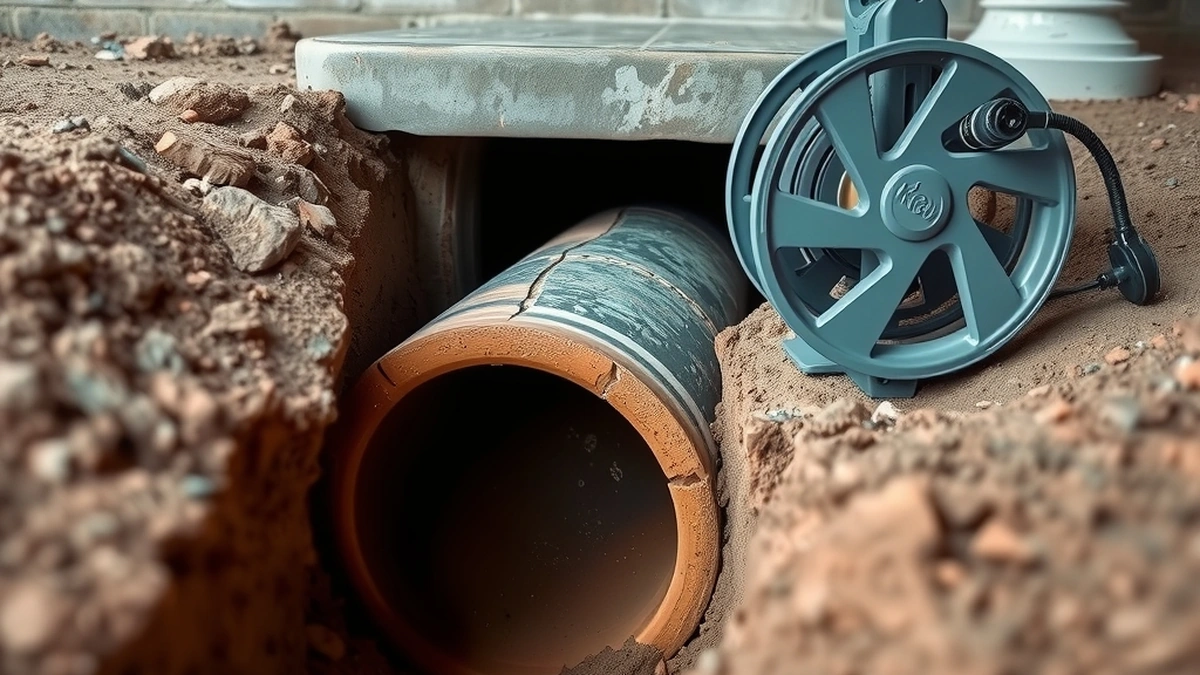
A collapsed pipe is prevented by keeping the line round and unloaded: camera-inspect every 18 to 24 months at $200 to $500, jet roots and grease at $300 to $800, and keep vehicles off the run. Once the wall folds, only repair remains.
- Camera inspection
- $200–$500
- Hydro jetting
- $300–$800
- Spot repair
- $1,500–$5,000
- Full replacement
- $5,000–$15,000
Some links on this page are affiliate links.If you buy through them we may earn a commission at no extra cost to you. We do not accept payment for rankings. Read the full disclosure.
A collapsed sewer pipe is prevented by keeping the pipe round, dry, and free of loads it was never built to carry. In practice that means three habits: inspect on a schedule, keep roots and grease out, and stop parking or building over the run. A collapse is almost never sudden. It is the last stage of a defect that was visible on camera for years.
What a collapsed pipe actually is
A collapsed pipe is a sewer line whose wall has failed and folded or crushed inward, so the bore is blocked or narrowed to a slit. The usual materials are vitrified clay, cast iron, and Orangeburg fibre pipe, all of which lose strength as they age and corrode or crack from the inside.
The failure sequence is consistent. A joint separates or a crack opens, roots find the moisture, grit and soil wash in, and the bedding under the pipe erodes into the line. Once the support under the invert is gone, the pipe spans an unsupported gap and the weight above it does the rest. That is why a collapse often appears as a depression in the lawn before it appears as a backup in the basement.
The money in prevention is small against the money in repair. A camera inspection runs $200 to $500, hydro jetting $300 to $800, a spot repair $1,500 to $5,000, and full replacement $5,000 to $15,000 before any driveway or landscaping restoration.
The four forces that flatten a pipe
Age alone does not collapse a pipe. Four forces combine with it.
Loss of bedding. Clay soil that swells and shrinks, or sand that washes out through a joint, leaves the pipe unsupported. The pipe is strong in a ring and weak along its length without soil contact.
Root pressure. Roots enter at joints and widen them a fraction of an inch at a time. The joint opens, soil enters, and the pipe loses support at exactly the point where the load is highest.
Surface load. A driveway poured over a line built for a lawn adds thousands of pounds of live load. So does a parked RV, a shed, or a dumpster placed on a soft spot.
Internal corrosion. Cast iron wastes from the inside out under hydrogen sulphide attack, and the wall thins until it cannot hold its shape. A camera pass shows the pitting long before the wall gives way.
What prevention costs against what repair costs
| Measure | Typical cost | Interval | What it prevents |
|---|---|---|---|
| Camera inspection | $200–$500 | 18–24 months | Finds cracks, offsets, and loss of bedding early |
| Hydro jetting | $300–$800 | As needed, often annual near trees | Root and grease buildup that hides defects |
| Root foaming or cutting | $300–$800 | 12–24 months | Joint damage from repeated root entry |
| Spot repair | $1,500–$5,000 | Once, when a defect is found | A single bad section turning into a run failure |
| Full replacement | $5,000–$15,000 | Once | The whole line, when prevention was skipped |
Run the arithmetic on a 4-year prevention plan: two inspections at $250 is $500, and two jetting visits at $400 is $800. The total is $1,300. That is below the $1,500 low end of a spot repair, and far below the $5,000 low end of a replacement. Prevention is not free, but it is the cheapest line item in the whole sewer budget.
A maintenance schedule that works
- Book a camera inspection at $200 to $500 and ask for the video file plus a written report that states footage, pipe material, and every defect.
- Have the line jetted at $300 to $800 whenever the camera shows grease, grit, or root mass, then re-inspect to confirm the pipe is clean.
- Treat roots on a 12 to 24 month cycle if any tree sits within 10 feet of the run, and never plant a willow, maple, or poplar closer than that.
- Keep vehicles, dumpsters, and sheds off the line, and check any driveway poured over it for settlement.
- Re-inspect after foundation work, an addition, or a driveway replacement, since vibration and new load both change the pipe’s support.
- Fix any defect the camera finds at the spot repair price rather than waiting for it to become a run.
The warning signs that mean prevention is already late
A collapse that has not happened yet still announces itself. Sinkholes or soft patches along the line, a sewer smell in the yard, gurgling fixtures, and a backup that returns after snaking are the standard four. Drains that are slow throughout the house rather than at one fixture point to the main rather than a branch.
The full list is worth reading once, and it is laid out in collapsed pipe warning signs with the order in which each symptom usually appears. A camera pass at $200 to $500 is the only way to tell a root blockage from a deformed wall, and the two have completely different price tags.
When prevention has already failed
Two repairs compete once the pipe is deformed.
Lining is a method that cures a resin tube against the inside of the existing pipe. At $4,000 to $12,000 it is the cheaper structural fix, but it needs a host pipe that still holds its shape. A section that has folded inward cannot be lined, because there is no round bore to cure against.
Replacement at $5,000 to $15,000 is the answer when the pipe has lost its profile. On a 50-foot run, a lining quote of $8,000 works out to $160 per foot, and a replacement quote of $12,000 works out to $240 per foot. That $80 per foot gap, or $4,000 across the run, is the cost of the collapse itself rather than the cost of the repair method.
What to ask before you sign anything
Ask for the camera footage on a USB stick or by email, not a verbal summary. Ask what the pipe material is, what the defect footage is, and whether the pipe is round enough to line. Ask whether the quote includes restoration of anything the crew disturbs, and ask what warranty covers the work and for how long.
The installation sequence explains what a lining day looks like, and the maintenance routine covers what keeps a repaired line in service. For the wider price picture across every method, start with sewer line repair cost.
The short version: a $250 inspection every two years is the cheapest insurance a sewer line has. The alternative is a $1,500 to $15,000 bill that arrives with a wet basement attached.
Frequently asked questions
How do I prevent a sewer pipe from collapsing?
Keep the pipe round and unloaded. Camera-inspect every 18 to 24 months at $200 to $500, jet roots and grease at $300 to $800, and keep vehicles, sheds, and tree planting off the line. Small defects get fixed before the wall folds.
How often should a sewer line be inspected?
Every 18 to 24 months on a line older than 40 years, and every three to five years on a newer one. Add an inspection after any foundation work, driveway replacement, or new tree within 10 feet of the line.
Does hydro jetting prevent collapse?
It prevents the blockage that leads to collapse, not the collapse itself. Jetting at $300 to $800 removes roots, grease, and grit so the pipe drains, but a cracked or flattened wall still needs a structural repair.
Can roots actually crush a clay pipe?
Roots rarely crush a sound pipe. They enter at joints and cracks, widen them over years, and let soil into the line. The wall then fails under the weight above it, which is why root control is a structural measure, not just a drain cleaning.
What does a collapse cost if prevention is skipped?
A spot repair runs $1,500 to $5,000 and full replacement $5,000 to $15,000, before driveway or landscaping restoration. A $650 inspection and jetting pair costs less than the low end of a spot repair.
Does homeowners insurance cover a collapsed sewer line?
Usually not. Most policies treat the pipe as maintenance and exclude it, though resulting damage such as a backed-up basement may be covered. Some insurers sell a service line endorsement that does include the pipe.
Sources
Some links are affiliate links.If you buy through them we may earn a commission at no extra cost to you. We do not accept payment for rankings. Read the full disclosure.