Root intrusion: what a fix costs
Cutting roots runs $300 to $800, a spot repair $1,500 to $5,000, lining $4,000 to $12,000. Three worked estimates and the line items behind each.
Fixing root intrusion costs $300 to $800 to cut the roots, $1,500 to $5,000 to repair the affected joint, $4,000 to $12,000 to line the run, or $5,000 to $15,000 to replace it. Add $200 to $500 for the camera inspection that decides which.
- Cutting roots
- $300 - $800
- Spot repair
- $1,500 - $5,000
- Trenchless lining
- $4,000 - $12,000
- Full replacement
- $5,000 - $15,000
Some links on this page are affiliate links.If you buy through them we may earn a commission at no extra cost to you. We do not accept payment for rankings. Read the full disclosure.
Fixing root intrusion costs $300 to $800 to cut the roots out, $1,500 to $5,000 to repair the joint they entered through, $4,000 to $12,000 to line the run, or $5,000 to $15,000 to replace it. Add $200 to $500 for the camera inspection that determines which of those you need. The spread is wide because the four options do genuinely different work.
What you are pricing
Roots in a sewer line are a symptom, not the fault. The fault is the opening they came through: a separated clay joint, a crack, or a fitting that was never sealed.
So a quote for “root removal” is a quote for symptom relief. A quote for a repair is a quote for the cause. Both are legitimate, and they are not interchangeable, which is why the price range runs from $300 to $15,000.
Three questions turn a vague quote into a comparable one:
- How many entry points did the camera find?
- Is the pipe displaced at any of them?
- Is the repair scoped to those points, or to the whole run?
Cost by method
| Method | Cost | Footage covered | Fixes the cause |
|---|---|---|---|
| Cutting or rooter | $300 - $800 | Whole line | No |
| Jetting with cutter head | $400 - $800 | Whole line | No |
| Spot repair | $1,500 - $5,000 | 6 - 15 ft at one point | Yes, at that point |
| Trenchless lining | $4,000 - $12,000 | Whole run | Yes, along the run |
| Full replacement | $5,000 - $15,000 | Whole run | Yes, and restores grade |
Cutting and jetting are the same price band because they are the same visit with a different head on the end of the hose. Neither closes anything.
Three worked estimates
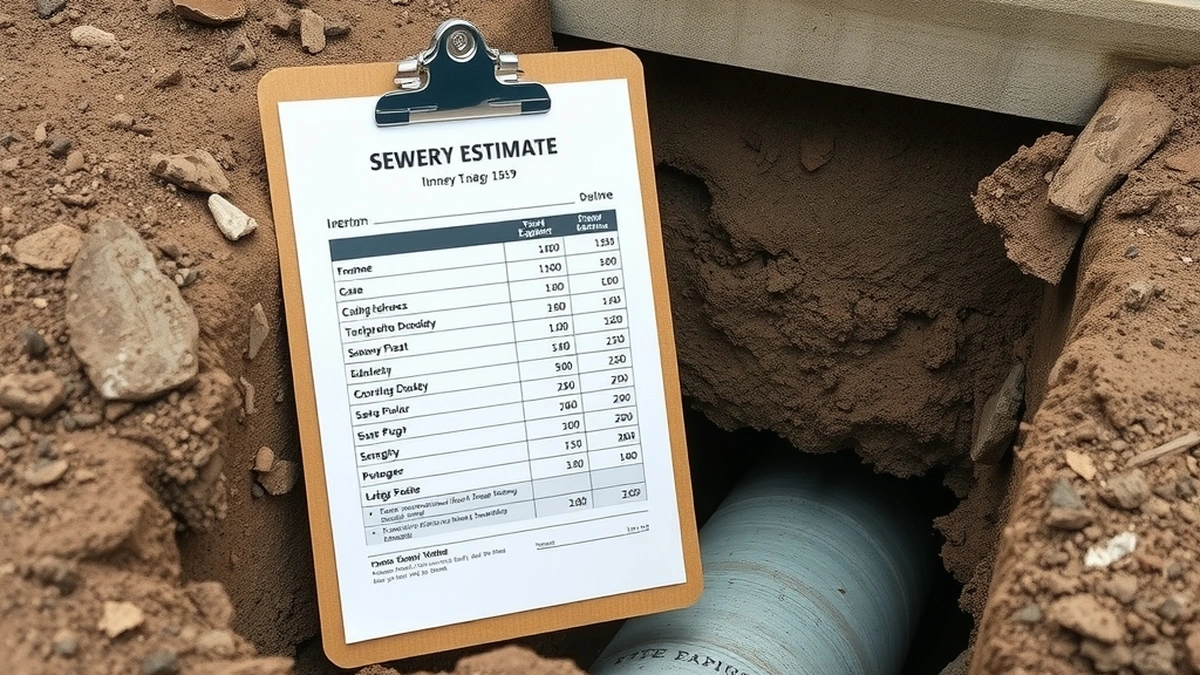
Estimate one: one root joint under a lawn. Camera $350, cutting $450 to confirm flow, spot repair of 10 feet at $2,400, sod and topsoil $250, permit $100. Total $3,550.
Estimate two: three root joints on a 60-foot clay run. Camera $400, cutting $600, three spot repairs at $2,600 each is $7,800, three restorations at $700 each is $2,100, permit $150. Total $11,050. That is more than a lining job, and it leaves three patches.
Estimate three: the same run, lined. Camera $400, cutting and cleaning $600, lining of 60 feet at $2,900 plus $5,500 for the balance of the run — call it $8,400 total for lining — one access pit restoration at $600, permit $150. Total $10,150. Cheaper than estimate two, one warranty, no joints left.
The lesson in estimates two and three is the one worth carrying: three spot repairs are almost never cheaper than one lining job. They are usually more expensive, because each repair carries its own mobilization and its own restoration.
What drives the number up
Depth. A joint at 18 inches is a hand dig. At six feet it needs shoring, and possibly a vac truck.
Surface. Lawn restores with sod at a few hundred dollars. Concrete, asphalt or a finished patio adds sawing, hauling and a repour, which can pass $2,000 on its own.
Number of entry points. Each one is a separate excavation or a separate lining transition.
Pipe material. Clay cuts and couples easily. Cast iron needs cutting and transition fittings. Orangeburg cannot be repaired and must be replaced.
Tree removal. If the tree that caused the problem stays, the repair buys time. Removing a mature tree runs $500 to $2,000 and is a separate decision with its own consequences for the yard.
Permits. $50 to $500 depending on the municipality, and the contractor usually pulls it.
The camera is the cheapest line on the invoice
At $200 to $500, the inspection is 5 to 10 percent of a repair bill and it determines the entire scope.
Without it, a contractor is guessing. With it, you can check three things:
- How many joints show roots. One is a spot repair. Four is a lining job.
- Whether the pipe is displaced. A joint that has shifted is a structural repair, not a cleaning.
- Whether there is a belly. Roots plus standing water means the pipe has lost fall, and lining will not fix that.
Ask for the video file, not just a verbal summary. A recording with footage marks lets a second contractor quote the same job, which is how you get comparable numbers.
The method comparison in more detail is in root intrusion repair options, and the full range across all sewer work is in how much sewer line repair costs.
Cleaning forever versus fixing once
The most common choice is annual cutting. Here is what it costs over time.
- One visit a year at $550 for 10 years = $5,500.
- Add two emergency call-outs at $900 each = $7,300.
- A lining job at $9,000 lasts 50 years and costs $180 a year on a straight-line basis.
The cash-flow comparison favours cutting in the short term and lining in the long term. The decision should turn on pipe condition, not on the annual number: a line with fine roots at tight joints can be maintained for years, while a line with displaced joints is deteriorating whether or not it is cleaned.
What to ask before you sign
- Will the price include the camera inspection, before and after?
- How many entry points did you find, and where?
- Is the quote for those points or for the whole run?
- What restoration is included, by area and material?
- What warranty covers a return of roots, and for how long?
- If the repair fails, what is the remedy?
A quote that answers all six can be compared to another that answers all six. A quote that says “root removal, from $1,500” cannot be compared to anything.
For the prevention plan that reduces the chance of a second bill, see root intrusion prevention. If the roots have already caused a backup, sewage backup cost covers the cleanup side.
Frequently asked questions
How much does it cost to fix root intrusion in a sewer line?
Cutting the roots costs $300 to $800. A spot repair of the affected joint is $1,500 to $5,000, lining the run is $4,000 to $12,000, and full replacement is $5,000 to $15,000.
Why is there such a wide range on a root repair?
Depth and surface. A joint two feet under a lawn is a short dig. The same joint under six feet of fill and a concrete driveway needs shoring, sawing and a repour, which can add $3,000.
Does insurance pay for root damage to a sewer line?
Usually not, because roots are treated as a maintenance issue. Sewage damage inside the house may be covered, and some policies sell a service line endorsement that includes the pipe.
Is lining cheaper than repairing each root joint?
On a run with three or more affected joints, yes. Three spot repairs at $3,000 each is $9,000 plus three restorations, which is the same money as lining the whole run once.
How much does a camera inspection add?
Typically $200 to $500, and it is not optional if you want the right repair. Without it, nobody knows whether the roots are at a tight joint or a broken section.
Can I just cut the roots every year instead?
You can. At $550 a visit, ten years costs $5,500 with no improvement in the pipe. That is often close to the cost of a repair that ends the problem.
Sources
Some links are affiliate links.If you buy through them we may earn a commission at no extra cost to you. We do not accept payment for rankings. Read the full disclosure.