Root intrusion: repair options and what they fix
Four ways to deal with roots in a sewer line, from a $300 to $800 cutting pass to a $12,000 lining job, and how the camera decides between them.
Root intrusion has four repair options: cutting at $300 to $800, spot repair at $1,500 to $5,000, trenchless lining at $4,000 to $12,000, or replacement at $5,000 to $15,000. The camera decides which, because roots at an intact joint differ from roots at a broken one.
- Cutting and jetting
- $300 - $800
- Spot repair
- $1,500 - $5,000
- Trenchless lining
- $4,000 - $12,000
- Full replacement
- $5,000 - $15,000
Some links on this page are affiliate links.If you buy through them we may earn a commission at no extra cost to you. We do not accept payment for rankings. Read the full disclosure.
Root intrusion has four repair options, and they sit at very different prices: cutting the roots at $300 to $800, a spot repair of the affected joint at $1,500 to $5,000, trenchless lining at $4,000 to $12,000, or full replacement at $5,000 to $15,000. Which one is correct depends on what the camera shows at the entry point, not on how slow the drain feels.
What root intrusion is
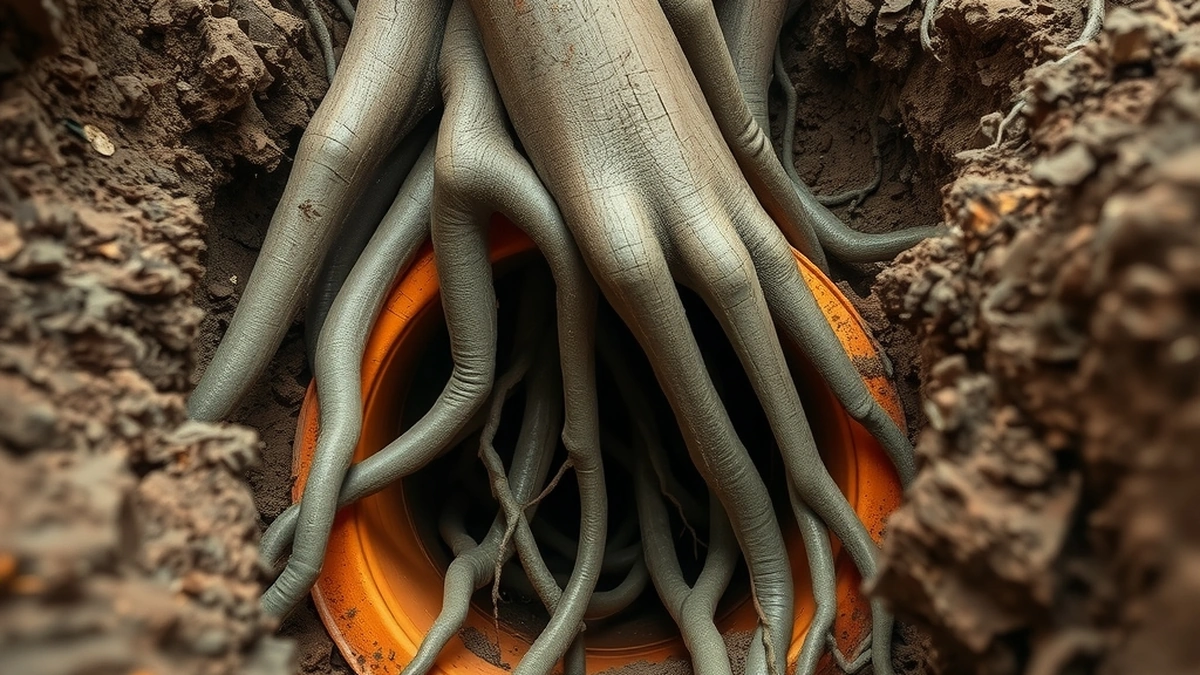
Root intrusion is the growth of tree or shrub roots into a sewer pipe through joints, cracks or failed connections, where the roots find water, nutrients and warmth.
Roots do not usually break a sound pipe to get in. They exploit a pipe that already has a gap — a clay joint that has separated by a fraction of an inch, a hairline crack, or a fitting that was never quite seated. The root hair enters, feeds, and thickens. Over years the root mass widens the opening and the pipe fails further.
That sequence matters for the repair decision. If the joint was sound, there would be no roots. So root intrusion is always a sign that something was already open.
The four options, and what each one actually does
| Option | Cost | What it does | How long it lasts |
|---|---|---|---|
| Cutting or jetting | $300 - $800 | Removes the root mass | 6 months to 3 years |
| Spot repair | $1,500 - $5,000 | Replaces the damaged section | 30 - 50 years |
| Trenchless lining | $4,000 - $12,000 | Seals the whole run from inside | 50 years |
| Full replacement | $5,000 - $15,000 | New pipe, new grade | 50 - 100 years |
Cutting is maintenance, not repair. It is legitimate on a line where the roots are hair-fine and the joints are tight, and it is a stopgap on a line where the joint has opened.
Spot repair is the targeted answer. It digs or pits at one location, replaces 6 to 15 feet, and leaves the rest of the run alone. It is right when there is one bad joint and the rest of the pipe is sound.
Lining covers the whole run. It is right when there are roots at multiple joints, or when the pipe is cracked in several places along its length.
Replacement is right when the pipe has lost grade, when it has collapsed in more than one place, or when it is Orangeburg or badly deteriorated clay.
What the camera changes
The same symptom — a slow drain and a gurgling toilet — produces four different recommendations depending on the recording.
Roots at a tight joint, no displacement. The pipe is intact; the joint is infiltrating. Cutting and jetting restores flow. Plan to repeat, and consider lining at the next failure rather than the first.
Roots at an offset joint. The pipe has shifted. Cutting buys time; a spot repair or lining fixes it. This is the most common real-world finding.
Roots through a cracked or broken section. The pipe has failed locally. Spot repair at $1,500 to $5,000 is the targeted fix.
Roots at four or more joints along 60 feet. The run is failing broadly. Lining at $4,000 to $12,000 is usually cheaper than four spot repairs at $3,000 each, which would total $12,000 plus four restorations.
That last comparison is the one homeowners miss. Four spot repairs are not cheaper than one lining job. They are usually more expensive and leave four separate warranties.
The arithmetic of waiting
Cutting roots every year is the most common choice and rarely the cheapest one over a decade.
- Annual cutting at $550 for 10 years = $5,500.
- One lining job at $9,000 = $9,000 over 50 years, or $180 a year.
The break-even is about 16 years on those numbers, which makes cutting look reasonable. But the comparison omits the emergencies. A root mass that suddenly blocks on a holiday weekend costs $500 to $1,500 for the call-out, on top of the scheduled cleaning. Two of those in a decade turns the $5,500 into $7,500.
It also omits the damage. Roots that have widened a joint let soil into the pipe and water out of it. That is how a small infiltration becomes a void under a driveway.
The cost breakdown by method is in root intrusion cost, and the prevention side is in root intrusion prevention.
What actually keeps roots out
Nothing keeps roots out of a pipe that already has an opening. What works is closing the opening.
- Lining covers joints and cracks with a continuous wall. Roots have no path.
- Spot repair with a sealed coupling closes one joint.
- Pipe replacement in PVC with solvent-welded joints removes the joint entirely.
- Chemical root treatments such as copper sulfate slow regrowth but do not seal anything, and they are a maintenance product rather than a repair.
Cutting plus chemical treatment is a legitimate long-term plan for a line with fine roots and intact joints. It is not a plan for a line with offsets or cracks.
How to choose, step by step
- Book a camera inspection at $200 to $500 and ask for the video file.
- Ask where the roots enter — joint, crack or fitting — and whether the pipe has shifted.
- Get a cutting quote at $300 to $800 as the baseline, even if you intend to repair.
- Get one spot repair quote and one lining quote priced on the same footage.
- Compare totals including restoration, not just the repair line.
- Ask what warranty covers a return of roots at the repaired location.
The options in more detail are set out in trenchless lining vs spot repair and pipe bursting vs full replacement. If the camera shows a fold or a collapse rather than roots, start with collapsed pipe repair instead.
Frequently asked questions
What is the cheapest way to fix root intrusion?
Cutting the roots with a rooter or jetting with a cutter head, at $300 to $800. It restores flow for months to a few years, but it does not close the joint the roots entered through.
Do roots come back after cutting?
Yes, unless the entry point is sealed. Roots regrow toward the water source, and a joint that admitted roots once will admit them again. Lining or replacing the section removes the entry point.
How do I know if roots have cracked the pipe?
A camera inspection at $200 to $500 shows it. Fine roots at a tight joint are infiltration. Roots growing through a visible crack or offset mean the pipe has failed at that point.
Can you line a pipe that has roots in it?
Yes, after the roots are cut and the wall is cleaned. The liner then covers the joints, so roots have no path back in. Lining over an uncut root mat will fail.
Does homeowners insurance cover root intrusion?
Usually not. Insurers treat roots as a maintenance issue. Resulting damage, such as sewage backup into the house, may be covered, and some policies sell a service line endorsement.
Which trees cause the most sewer damage?
Any tree within about 30 feet of the line can reach it, but willows, maples, elms, poplars and figs are the most commonly cited. Age and soil moisture matter more than species alone.
Sources
Some links are affiliate links.If you buy through them we may earn a commission at no extra cost to you. We do not accept payment for rankings. Read the full disclosure.