Sewer Line Repair cost per square foot
Sewer repair is priced per linear foot, not square foot. Here is how to convert a quote into dollars per square foot of trench, with worked US examples.
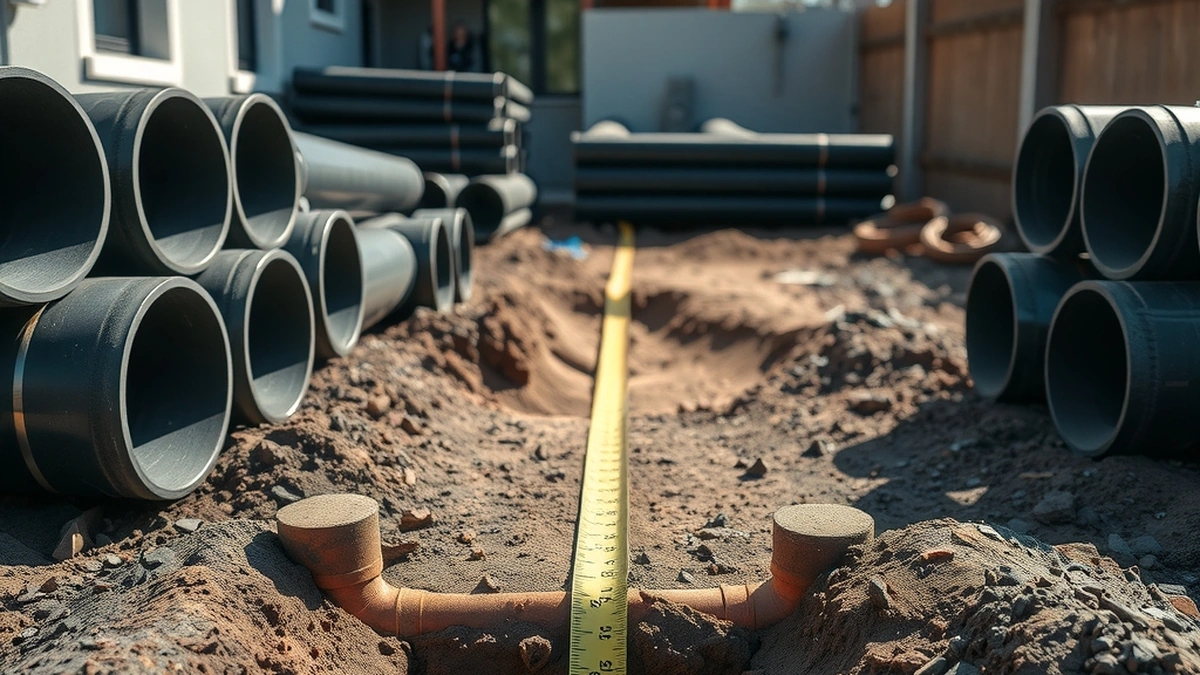
Sewer repair is not sold by square foot. It is priced per linear foot of pipe, typically $83 to $250 per foot for replacement, which works out to roughly $42 to $125 per square foot of 2-foot-wide trench on a 60-foot run.
- Cost per linear foot
- $83–$250
- Trench width
- 18–24 inches
- Full replacement
- $5,000–$15,000
- Camera inspection
- $200–$500
Some links on this page are affiliate links.If you buy through them we may earn a commission at no extra cost to you. We do not accept payment for rankings. Read the full disclosure.
Sewer line repair is not priced by square foot, and any quote that arrives that way is using the wrong unit. The work follows the pipe, so contractors price per linear foot, commonly $83 to $250 per foot for replacement. Converted to trench area on a 60-foot run, that is roughly $42 to $125 per square foot of a 2-foot-wide excavation.
Why area is the wrong unit for a pipe
Sewer line repair cost per square foot is a conversion, not a market rate. Pipe is a line, not a surface. Labor, pipe, bedding, and backfill all scale with the length of the run; the width of the trench is set by the digging method, not by how much work the job needs.
A mini-excavator cuts a trench 18 to 24 inches wide regardless of whether the run is 30 feet or 90 feet. So the square footage of the trench grows only because the length grows, which means the per-square-foot number is just the per-foot number divided by a constant. It is useful for comparing against concrete or landscaping work, and useless as a shopping metric.
The conversion, worked out
Take a 60-foot replacement at the low end of the national range.
$5,000 ÷ 60 feet = $83.33 per linear foot. A 2-foot-wide trench over 60 feet is 60 × 2 = 120 square feet. $5,000 ÷ 120 = $41.67 per square foot.
Now the high end. $15,000 ÷ 60 = $250 per linear foot. $15,000 ÷ 120 = $125 per square foot.
| Job | Total | Run | Per linear foot | Trench area | Per square foot |
|---|---|---|---|---|---|
| Replacement, low | $5,000 | 60 ft | $83.33 | 120 sq ft | $41.67 |
| Replacement, high | $15,000 | 60 ft | $250.00 | 120 sq ft | $125.00 |
| Lining, low | $4,000 | 60 ft | $66.67 | minimal | not meaningful |
| Lining, high | $12,000 | 60 ft | $200.00 | minimal | not meaningful |
| Spot repair | $3,000 | 8 ft | $375.00 | 16 sq ft | $187.50 |
Two things jump out. First, lining has no meaningful square-foot price because it barely opens ground. Second, spot repair looks expensive per foot at $375, and it is, because mobilization, permits, and equipment delivery are fixed costs spread over a short run. The per-foot number is only comparable between jobs of similar length.
What the per-foot price includes
A fair per-foot price is not just pipe and a dig. It carries:
- Camera inspection at $200 to $500, or a share of it
- Permit fees and inspection scheduling
- Excavation, shoring, and dewatering where needed
- Pipe, fittings, couplings, and bedding stone
- Backfill in lifts with compaction
- Disposal of old pipe and spoil
- Restoration of lawn, concrete, or pavers
- Testing and a post-repair camera pass
Quotes that exclude restoration can look 20 to 30 percent cheaper per foot and are not. Ask what the per-foot price omits before comparing it with anything.
What moves the number up
Depth is the largest single factor. A line 3 feet down is routine. A line 8 feet down needs shoring, a larger machine, and more backfill, and the per-foot price can roughly double.
Access is second. A run under a lawn is cheap to restore. A run under a concrete driveway, a sidewalk, or a finished patio adds saw-cutting, removal, disposal, and a concrete pour. That restoration can add $1,000 to $3,000 to a job regardless of length.
Length cuts the other way. Longer runs lower the per-foot price because fixed costs spread further. A 90-foot run at $10,000 is $111 per foot. A 20-foot run at $6,000 is $300 per foot, even though the total is lower.
Ground conditions matter too: rock, high water table, and root-choked soil all slow the crew.
Applying a square-foot figure to restoration
There is one place where square footage is genuinely useful: the surface work. Concrete replacement typically runs $8 to $15 per square foot, and sod runs $1 to $2 per square foot installed. If your trench crosses 120 square feet of driveway, a $12 per square foot concrete figure adds 120 × $12 = $1,440 to the job.
That is the right way to use area. Price the pipe by the foot, then price the surface by the square foot, then add them.
Comparing quotes without getting fooled
- Ask each contractor for the run length in feet and the total price.
- Divide total by length to get dollars per linear foot.
- List what each quote excludes: permit, restoration, testing, disposal.
- Add the excluded items back in before comparing.
- Check the per-foot number only against quotes for similar run lengths and similar access.
If one quote is $150 per foot and another is $240 per foot for the same 60-foot run, the difference is $5,400. That gap is worth asking about in writing, and the answer will usually be method, restoration, or depth.
The number to actually remember
For a typical US residential replacement, budget $83 to $250 per linear foot, or $5,000 to $15,000 for a 60-foot run. For a spot repair, budget $1,500 to $5,000 regardless of length, because the fixed costs dominate. For lining, budget $4,000 to $12,000.
Our full breakdown in how much sewer line repair costs explains where each of those dollars goes, and sewer line repair installation shows the sequence that the per-foot price is buying. If you are deciding whether to spend it at all, is sewer line repair worth it runs the comparison against the alternatives.
Per square foot is a conversion you can do in your head. Per linear foot is the number contractors actually quote, so that is the one to compare.
Frequently asked questions
How much does sewer line repair cost per square foot?
Converted from linear pricing, a 60-foot replacement at $5,000 to $15,000 works out to about $42 to $125 per square foot of 2-foot-wide trench. The per-foot price is the real unit.
Why do contractors price sewer work per linear foot?
Because the work follows the pipe. Labor, excavation, bedding, and pipe all scale with length along the run, while width is fixed by the trench and the machine.
What is a typical sewer repair cost per foot?
Full replacement commonly runs $83 to $250 per linear foot in the US, spot repair runs higher per foot because mobilization dominates, and lining runs $67 to $200 per foot.
Does trench width change the price much?
Only indirectly. A wider trench means more excavation, backfill, and restoration, but contractors price the run by length and adjust for access, not by measuring area.
How do I compare a per-foot quote with a per-square-foot quote?
Convert both to total cost for the same run length, then divide by linear feet. Anything else is comparing different units and will mislead you.
Is a shorter run cheaper per foot?
Often it is more expensive per foot. Mobilization, permits, and equipment delivery are fixed costs, so a 20-foot job can run $200 to $350 per foot while a 90-foot job runs $110 to $150.
Sources
Some links are affiliate links.If you buy through them we may earn a commission at no extra cost to you. We do not accept payment for rankings. Read the full disclosure.