Types of sewer line repair
The five main sewer repair types, spot repair, open trench, cured-in-place lining, pipe bursting, and slip lining, with US costs and which damage each fits.
Five sewer repair types cover most homes: spot repair at $1,500 to $5,000, open trench replacement at $5,000 to $15,000, cured-in-place lining at $4,000 to $12,000, pipe bursting, and slip lining.
- Spot repair
- $1,500–$5,000
- Open trench replacement
- $5,000–$15,000
- CIPP lining
- $4,000–$12,000
- Camera inspection
- $200–$500
Some links on this page are affiliate links.If you buy through them we may earn a commission at no extra cost to you. We do not accept payment for rankings. Read the full disclosure.
Sewer line repair types fall into two families: methods that open the ground and methods that work through the pipe. Spot repair at $1,500 to $5,000 and open trench replacement at $5,000 to $15,000 dig; cured-in-place lining at $4,000 to $12,000, pipe bursting, and slip lining do not. Which family applies is decided by a $200 to $500 camera inspection, not by preference.
The five types at a glance
| Type | Typical cost | Opens ground | Best for | Expected life |
|---|---|---|---|---|
| Spot repair | $1,500–$5,000 | Yes, small area | One isolated crack, break, or joint | 10–25 years |
| Open trench replacement | $5,000–$15,000 | Yes, full run | Collapse, multiple failures, end-of-life pipe | 50–100 years |
| CIPP lining | $4,000–$12,000 | Access pits only | Long cracked run in a round pipe | 25–50 years |
| Pipe bursting | $5,000–$15,000 | Access pits only | Deteriorated pipe that can be replaced in place | 50–100 years |
| Slip lining | $4,000–$12,000 | Access pits only | Sound host pipe with capacity to spare | 25–50 years |
Costs overlap because scope overlaps. A 30-foot lining and a 30-foot replacement can land within $2,000 of each other, and the cheaper one is not automatically the right one.
Spot repair
Spot repair cuts out a short damaged section, usually 3 to 10 feet, and couples in new pipe. It is the least invasive dug option and the least expensive at $1,500 to $5,000.
It is appropriate when the camera shows a single defect in a pipe that is otherwise sound: one fracture, one root entry at a joint, one offset. It is inappropriate when the same problems repeat along the run, because then you are paying mobilization costs for each patch.
Per foot, spot repair looks expensive. A $3,000 repair over 8 feet is $375 per foot, against $167 per foot for a $10,000 replacement over 60 feet. That is not a mark-up; it is fixed costs, permits, and equipment delivery spread over a short job. Judge it on total cost for the defect, not on the per-foot figure.
Open trench replacement
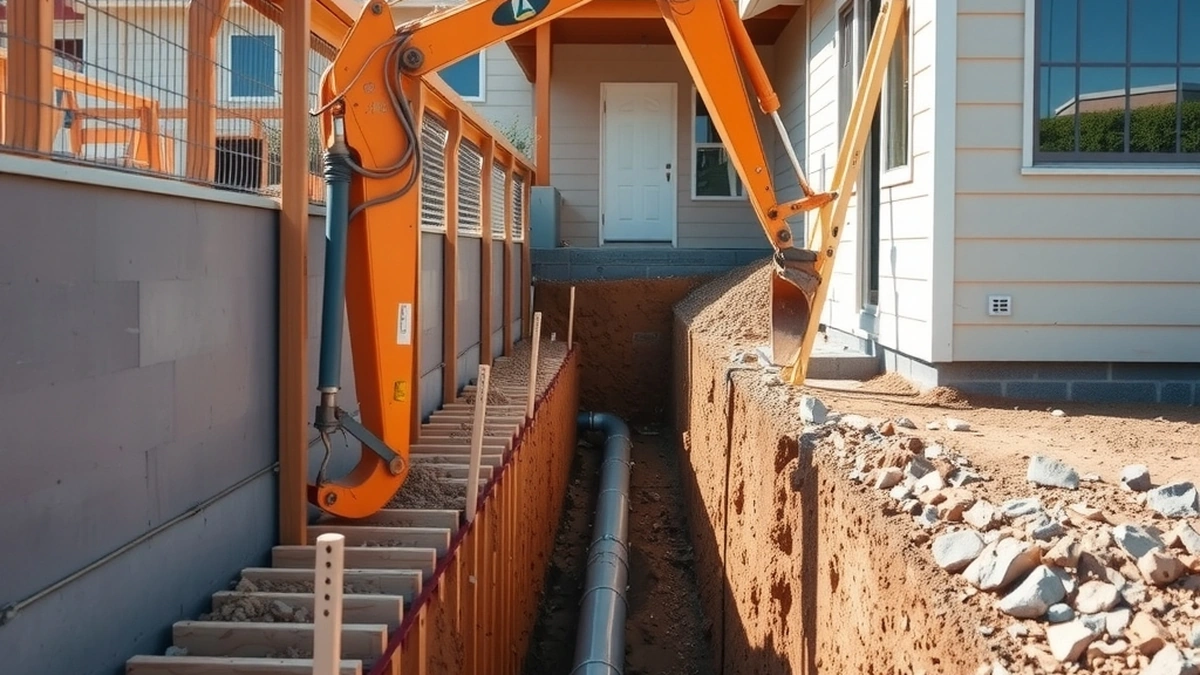
Open trench replacement excavates along the run, removes the old pipe, and lays new pipe on fresh bedding. At $5,000 to $15,000 it is the most expensive and the most complete option.
It is the right answer when the pipe has collapsed, when it has multiple failures along its length, when it is Orangeburg, or when cast iron has lost enough wall thickness that patching is pointless. It is also the fallback when a liner cannot be installed because the host pipe is out of round.
Depth drives the price more than length does. A 3-foot line is routine excavation; an 8-foot line needs shoring and more backfill. Add driveway or sidewalk restoration and a mid-range job moves toward the top of the range. Our guide to sewer line repair installation covers the sequence in detail.
Cured-in-place lining
Cured-in-place pipe lining, usually shortened to CIPP, pulls a felt tube saturated with resin through the old pipe, inflates it against the wall, and cures it with heat or ultraviolet light. The result is a new structural pipe inside the old one, at $4,000 to $12,000.
The advantages are speed and surface protection. Access is usually two pits, one at each end, and the yard, driveway, and mature trees stay intact. A lining job often finishes in a day, against two or three for open trench.
The limits are structural. The host pipe must be round and able to hold the liner while it cures. A collapsed, flattened, or heavily offset pipe cannot be lined, because the liner simply takes the shape of the defect. Roots must be cut and the wall cleaned before installation, which is why jetting at $300 to $800 is often part of the job.
A lining also reduces the internal diameter slightly, which matters on a line that is already undersized or has low slope.
Pipe bursting and slip lining
Pipe bursting pulls a conical head through the old pipe, fracturing it outward into the surrounding soil while dragging new high-density polyethylene behind it. The old pipe becomes the path for the new one, so the diameter can stay the same or increase. Costs land in the replacement band of $5,000 to $15,000, because what you end up with is a new pipe.
Pipe bursting suits deteriorated pipe that is beyond lining, and it handles slight deformation that would disqualify CIPP. It needs larger access pits than lining and cannot be used where the line runs close to other utilities or under a structure that cannot tolerate soil displacement.
Slip lining inserts a smaller new pipe inside the old one without breaking it out. It is simple and reliable, but it costs capacity, so it only works when the original pipe was oversized for the load. A 4-inch line slipped inside another 4-inch line is not possible; the new pipe must be smaller.
Matching the method to the damage
| Camera finding | First choice | Why |
|---|---|---|
| One crack or break, sound pipe | Spot repair | Cheapest correct fix |
| Roots at one joint | Spot repair or local lining | Removes the entry point |
| Cracks along 20+ feet, pipe round | CIPP lining | Covers the run without digging |
| Multiple offsets, pipe still round | Lining or pipe bursting | Restores a continuous wall |
| Collapsed or flattened section | Open trench or pipe bursting | Lining cannot restore shape |
| Orangeburg anywhere | Open trench replacement | No structural life remains |
| Oversized pipe, no capacity concern | Slip lining | Cheap, fast, capacity loss acceptable |
| Sagging belly over a long run | Open trench replacement | Must re-establish slope |
The two rules that carry most of the decision: lining needs a round host, and replacement is the only method that resets slope. Everything else is a cost and access trade.
Choosing in order
- Get a camera inspection at $200 to $500 and keep the recording.
- Ask for the defect length in feet, the pipe material, and whether the pipe is still round.
- Rule out lining if the pipe is collapsed, flattened, or has a long belly.
- Rule out spot repair if the damage repeats along the run.
- Get itemized quotes for the two methods that survive those filters.
- Compare total cost including permits, testing, and restoration, then compare expected life.
For the price detail behind each row, see how much sewer line repair costs; for how long each method lasts, how long sewer line repair lasts. If you are weighing whether to fix the pipe at all, when a sewer repair is worth it reads the same camera findings against the cost of replacement.
The method is not a preference. It is a conclusion that the camera supports or does not.
Frequently asked questions
What are the main types of sewer line repair?
Spot repair, open trench replacement, cured-in-place pipe lining, pipe bursting, and slip lining. The first two open the ground; the last three work through the existing pipe.
Which sewer repair method is cheapest?
Spot repair is cheapest at $1,500 to $5,000 when the damage is isolated. Lining at $4,000 to $12,000 beats full replacement at $5,000 to $15,000 when the pipe can host a liner.
What is CIPP lining?
Cured-in-place pipe lining pulls a resin-saturated tube into the old pipe, inflates it against the wall, and cures it into a new structural pipe inside the old one.
How does pipe bursting work?
A conical bursting head is pulled through the old pipe, breaking it outward while dragging new high-density polyethylene behind it. It replaces the pipe without an open trench along the run.
Can any sewer pipe be lined?
No. The host pipe must be round and structurally able to hold the liner during cure. Collapsed, flattened, or heavily offset pipe needs replacement instead.
How long does each repair type last?
Spot repairs typically last 10 to 25 years, linings 25 to 50, and new PVC or HDPE pipe 50 to 100 years, assuming correct installation and normal soil conditions.
Sources
Some links are affiliate links.If you buy through them we may earn a commission at no extra cost to you. We do not accept payment for rankings. Read the full disclosure.