Full replacement installation: the work, day by day
Full sewer replacement installation runs 2 to 5 days: locate, dig, set slope, connect, inspect, backfill, restore. Here is each stage and what to watch.
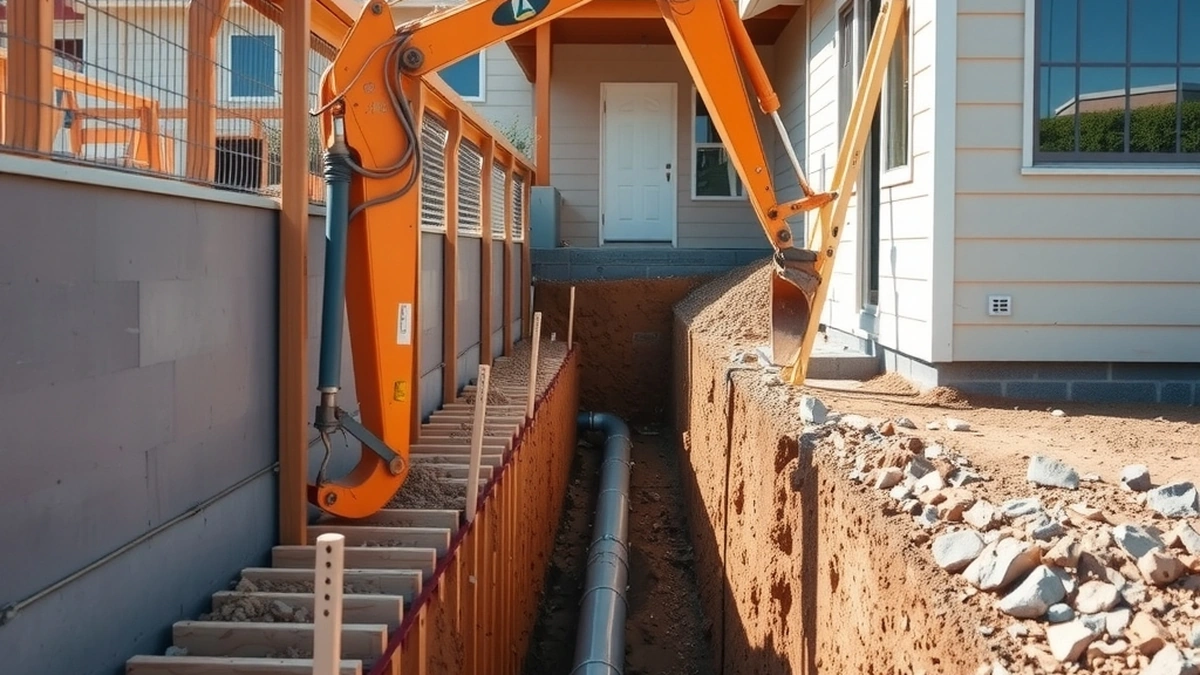
Full replacement installation replaces the entire sewer line in 2 to 5 days: camera and locate, excavate, set the new pipe to slope, connect at both ends, pass inspection, backfill and compact, then restore the surface. Concrete restoration usually follows on a second visit.
- Duration
- 2 to 5 days
- Full replacement cost
- $5,000 - $15,000
- Inspection before backfill
- Required
- Concrete cure
- 24 to 72 hours
Some links on this page are affiliate links.If you buy through them we may earn a commission at no extra cost to you. We do not accept payment for rankings. Read the full disclosure.
Full replacement installation is a 2 to 5 day job that replaces the pipe from the house to the municipal main. The sequence is fixed even when the method is not: find the route, open it, lay new pipe to a continuous slope, connect both ends, pass inspection, then put the ground back. The day the line is cut over is the only day without sewer service.
What the work is
Full replacement means the old lateral is taken out of service entirely and a new pipe is installed along the route, either in an open trench or by pipe bursting. It is not a repair, and it is not a liner: the pipe in the ground is new, and so is every joint. That is why the price band is $5,000 to $15,000 rather than the $1,500 to $5,000 of a spot repair.
Three methods
| Method | Excavation | Best suited to | Disruption |
|---|---|---|---|
| Open trench | Continuous trench along the route | Any pipe, any depth, any condition | Highest, full route |
| Pipe bursting | Entry and exit pits only | Sound but failing host pipe, few fittings | Moderate, two pits |
| Lining | Cleanout access only | Intact host pipe, not a true replacement | Low, no digging |
The choice is made on camera evidence and on what sits above the line. A collapsed pipe rules out both bursting and lining. A route under a finished driveway favors bursting, because two pits disturb less than a continuous trench.
Open trench, step by step
This is the sequence a competent crew runs on a conventional replacement.
- Camera and locate. The existing line is cameraed and located, and the route is marked on the surface. Utility locates are requested through 811 and private lines are marked separately.
- Excavate and shore. The trench is opened from the house connection to the municipal main, with shoring or sloping wherever depth requires it. Spoil is staged on tarps or hauled out.
- Set the new pipe. Pipe is laid on bedding at a continuous fall, typically a quarter inch per foot for a 4-inch line, with cleanouts at the house and at intervals along the run. Fittings are glued or banded depending on material.
- Connect both ends. The house connection is tied into the building drain, and the downstream end is tied into the municipal wye or the septic tank inlet. This is the step that decides whether the job passes inspection.
- Test and inspect. The line is water tested and cameraed, and the municipal inspector signs off before any backfill. A failed inspection means the pipe comes back out of the ground.
- Backfill, compact, restore. Bedding and backfill go in lifts, compacted to limit later settlement, and the surface is restored. Concrete is typically a second visit after curing.
Step 5 is the one to be present for. Once the trench is closed, every correction costs excavation again.
Pipe bursting, in outline
Bursting replaces pipe without a continuous trench. The crew opens a pit at each end, feeds a bursting head through the old line from the upstream pit, and pulls new high-density polyethylene behind it. The old pipe fractures outward into the soil and the new pipe occupies its path.
It fits when the old pipe is deteriorating but still continuous, when the route has few bends, and when the new line does not need to be upsized much. It does not fit when the pipe has collapsed, when there are major offset joints, or when the route passes close enough to a foundation or utility that outward fracturing is a risk.
The pipe bursting installation sequence covers pit design and pulling forces in more detail.
The timeline
| Day | Open trench | Pipe bursting |
|---|---|---|
| 1 | Locate, excavate, stage spoil | Locate, dig entry and exit pits |
| 2 | Lay pipe, set slope, connect | Assemble and pull, connect ends |
| 3 | Inspect, backfill, compact | Inspect, backfill pits |
| 4 to 5 | Rough restore, concrete prep | Restore two pits only |
| Later | Concrete pour and cure | Concrete cure where needed |
Weather moves these numbers. Frozen ground slows excavation, and saturated soil can stop a backfill because compaction cannot be verified in mud.
Permits and inspection
Most jurisdictions require a permit for a sewer lateral replacement, and the permit is not paperwork. It is what triggers the municipal inspection that protects you.
The contractor should pull the permit, not you. A company that asks the homeowner to pull it is usually a company without the license or insurance to hold one.
The inspector looks for three things: continuous slope without a sag, watertight joints, and correct connection at both ends. Camera footage and a water test are the usual evidence. Get a copy of the signed inspection card; it matters at resale.
What changes the plan mid-job
Three surprises are common enough to plan around.
A utility across the route. Gas, water, and electric lines cross laterals more often than expected. Hand digging around them adds hours and sometimes requires the utility to stand by.
A collapsed section under a structure. If the old line passes under a porch or an addition, open trench may not be possible for that stretch, and the job shifts to bursting or to a short directional bore.
A deeper main than expected. The municipal main may sit lower than the drawings suggest, which means more excavation at the downstream end and a longer run of pipe.
Each of these should produce a written change order before the work continues. A verbal agreement on a price change is how disputes start, and it is the leading complaint in full replacement reviews.
What to do next
- Get the camera inspection at $200 to $500 and watch the footage before agreeing to replace anything.
- Confirm the route and depth in writing, with the footage measured from the house to the main.
- Ask which method is proposed and why, and get one alternative priced.
- Confirm the contractor pulls the permit and that the inspection happens before backfill.
- Photograph the open trench, the bedding, and the slope before the pipe is covered.
- Hold back final payment until the inspection card and the post-installation camera file are in hand.
The cost side of the same job is in full replacement cost, and the ways it goes wrong are in full replacement problems. For the method comparison, full replacement vs trenchless lining sets the two routes against each other.
Frequently asked questions
How long does a sewer line replacement take?
Most residential replacements take 2 to 5 working days, with a short run on open ground finishing in two and a long run under concrete taking a week including restoration.
Do I have to move out during a sewer replacement?
Usually not, but you will lose sewer service for several hours on the day the line is cut over. Many homeowners schedule the work for a weekday and limit water use during the changeover.
Who inspects a new sewer line?
The municipal sewer authority inspects the line before backfill, usually with a camera and a water test. The contractor schedules it, and the job cannot be backfilled until it passes.
How deep is a sewer line buried?
Residential laterals commonly sit 3 to 8 feet deep, driven by frost depth and the depth of the municipal main. Depth is the biggest single driver of excavation cost.
Can a sewer line be replaced without digging up the yard?
Yes, by pipe bursting or by lining. Bursting still needs entry and exit pits; lining needs no excavation but is a renewal of the old pipe rather than a replacement.
What happens to the old pipe?
On an open-trench job it is removed and hauled away. On a pipe bursting job it is fractured outward into the soil and the new pipe takes its place. On a lining job it stays in place as the host.
Sources
Some links are affiliate links.If you buy through them we may earn a commission at no extra cost to you. We do not accept payment for rankings. Read the full disclosure.