Slow drains everywhere: warning signs
The seven signals that every drain in the house is slowing for the same reason, which point to the main line, and the $200 to $500 test that confirms it.
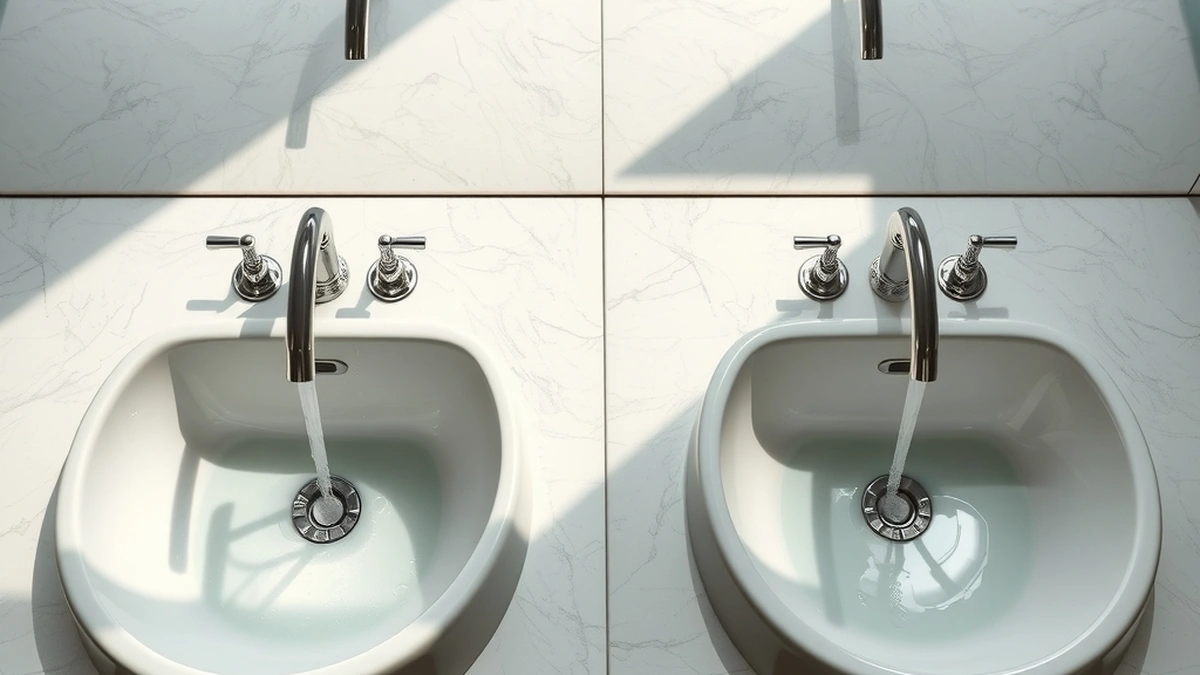
Warning signs that all drains are slowing for one reason include several fixtures draining slowly at once, gurgling, water backing up in one fixture when another drains, and a sewage smell in the basement. A camera inspection at $200 to $500 confirms the main line.
- Camera inspection
- $200 - $500
- Hydro jet
- $300 - $800
- Spot repair
- $1,500 - $5,000
- Emergency clear
- $500 - $1,500
Some links on this page are affiliate links.If you buy through them we may earn a commission at no extra cost to you. We do not accept payment for rankings. Read the full disclosure.
Slow drains everywhere are diagnosed by pattern, not by feel. If two or more fixtures on different floors slow down at the same time, the obstruction is in the shared main line. If one sink is slow and everything else is fine, it is a local clog. The difference decides whether you need a $20 fix or a $200 to $500 camera inspection, and it takes about a minute to check.
The seven signs, in order
1. Several fixtures slow at once. The strongest signal. Run the bathroom sink and the kitchen sink at the same time and compare.
2. Fixtures on different floors affected. A single branch can serve one bathroom. It cannot serve the kitchen and the upstairs bath. If both are slow, the problem is downstream.
3. Gurgling. Air being pulled through a trap as water drains. It means the pipe behind the fixture is partly blocked, or the vent is obstructed.
4. One fixture backing up when another drains. Running the washing machine fills the basement floor drain. The water is finding the lowest escape point because the main is blocked.
5. Slow recovery after rain. Drains slow during storms and return to normal afterwards. That is surcharge in the municipal main, which is a different problem with a different fix.
6. Sewage smell in the basement or yard. A persistent smell along the line points to a leaking joint or a partly blocked section.
7. A cleanout that seeps or looks wet. A cleanout under pressure shows at the cap first.
Local clog versus main line
| Test | Local clog | Main line |
|---|---|---|
| One fixture affected | Likely | Unlikely |
| Multiple fixtures, same floor | Possible | Likely |
| Fixtures on different floors | No | Yes |
| Gurgling elsewhere in house | No | Yes |
| Backs up when another fixture runs | No | Yes |
| Recurs after plunging | Sometimes | Yes |
Two rows are enough to decide. Different floors plus a backup when another fixture runs is the main line. That is not a subtle diagnosis, and it does not need a professional to confirm before you book one.
Why gurgling is worth taking seriously
A gurgle is the sound of a trap being siphoned. Water in the trap seal is pulled out by the pressure change, air enters behind it, and the drain makes a gulping noise.
Two causes:
- A partial blockage downstream restricts flow, so draining water pulls air through the trap instead of the vent.
- A blocked vent stops air entering the system at the top, with the same result at the trap.
Both are early-stage signals. A partial blockage can run for months before it closes. A blocked vent can be cleared for $200 to $600 and is much cheaper than the repair a neglected blockage eventually needs.
What the camera confirms
At $200 to $500, the inspection is the point at which a pattern becomes a price.
Ask the technician to note:
- The footage where flow is restricted.
- The cause — grease, roots, scale, a belly, a collapse, an offset.
- Whether water is standing upstream, which indicates lost fall.
- The condition of the pipe either side of the restriction.
The cause determines the cost. Grease is a $300 to $800 jet. Roots at a displaced joint are a $1,500 to $5,000 repair. A collapsed section is at least that and may be a replacement.
Without the recording, every quote you receive is a guess, and the range across guesses for the same symptom is $300 to $15,000.
The cost of waiting, in numbers
A slow drain that is tolerated for a year usually follows one of two paths.
Path one, treated early. Camera $350, jet $500, total $850. No repair needed, because the camera showed soft material in a sound pipe.
Path two, ignored. The line blocks on a weekend. Emergency clear $900. Camera afterwards $350. The camera finds roots and a belly, so a spot repair at $2,600. Total $3,850.
The difference is $3,000, and it is entirely a function of when the inspection happened. The pipe did not change in that year. The information did.
The repair ladder is in slow drains everywhere repair, and the pricing is in slow drains everywhere cost.
Seasonal patterns worth knowing
Slow drains often appear in spring and autumn rather than at random.
Spring. Snowmelt and rain raise the water table. Infiltration through old joints adds water to the system, and municipal mains run high. Drains slow for a few weeks and then recover.
Autumn. Holiday cooking puts grease into the system at the same time as more people are in the house. Most residential backups in the US cluster in the last six weeks of the year.
If your drains slow on a seasonal schedule, the cause is likely infiltration or surcharge rather than a blockage in your pipe, and the prevention measures differ.
What to do when you spot the signs
- Run two fixtures on different floors and compare the drain rate.
- Listen for gurgling at the nearest trap while water runs elsewhere.
- Check whether one fixture backs up when another drains.
- Book a camera inspection at $200 to $500 rather than a third clear.
- Compare the repair options at the footage the camera found.
- Fix the cause, and re-inspect a year later.
For prevention before it reaches this point, see slow drains everywhere prevention. If the line has already backed up, sewage backup signs covers the urgency levels, and how much sewer line repair costs sets the wider price context.
One last check that costs nothing: compare the drain rate of a fixture on the lowest floor with one on the highest. Water falls, so the lowest fixture is where a main-line problem shows first. If the basement drain is the slowest in the house and the upstairs bath is fine, the obstruction is close to the building drain rather than out at the street. That changes which cleanout the crew will open, and it is worth mentioning when you book.
Frequently asked questions
How do I know if slow drains are a main-line problem?
If two or more fixtures on different floors drain slowly at the same time, the obstruction is in the shared main line. A single slow fixture is usually a local clog.
Why do my drains gurgle but still drain?
A gurgle means air is being pulled through a trap because the pipe behind it is partly blocked or the vent is obstructed. It is an early sign, and the cheapest stage to investigate.
Is a slow drain always a blockage?
No. A blocked vent, a partially closed valve or a failing fixture can slow one drain. House-wide slowness across several floors is far more likely to be the main line.
What does it mean when one sink backs up into another?
It means the two fixtures share a branch or a main line and the obstruction sits between them. It is a strong sign that the problem is not at the fixture.
Can I test the main line myself?
You can run water at several fixtures and watch the cleanout, but you cannot see the pipe. A camera inspection at $200 to $500 is the only way to know what is causing it.
How quickly do slow drains become a backup?
It varies from weeks to a season. A line that has been slowing for months usually blocks within the year, often during a holiday or a cold snap when volume peaks.
Sources
Some links are affiliate links.If you buy through them we may earn a commission at no extra cost to you. We do not accept payment for rankings. Read the full disclosure.