Trenchless lining cost: what US homeowners pay
Trenchless lining runs $4,000 to $12,000 for most US homes, after a $200 to $500 camera inspection. Here is where the money goes and how to read a quote.
Trenchless lining costs $4,000 to $12,000 for most US homes, on top of a $200 to $500 camera inspection and a $300 to $800 cleaning. Linear feet, depth, diameter, and access decide where in that band your job lands.
- Trenchless lining
- $4,000–$12,000
- Camera inspection
- $200–$500
- Hydro jetting
- $300–$800
- Full replacement
- $5,000–$15,000
Some links on this page are affiliate links.If you buy through them we may earn a commission at no extra cost to you. We do not accept payment for rankings. Read the full disclosure.
Trenchless lining costs $4,000 to $12,000 for a typical US house, and that figure sits on top of two smaller bills: a $200 to $500 camera inspection and a $300 to $800 cleaning. The liner is the cheap part of the arithmetic. Access, footage, and what the camera finds are what move a quote from one end of the band to the other.
What the price actually covers
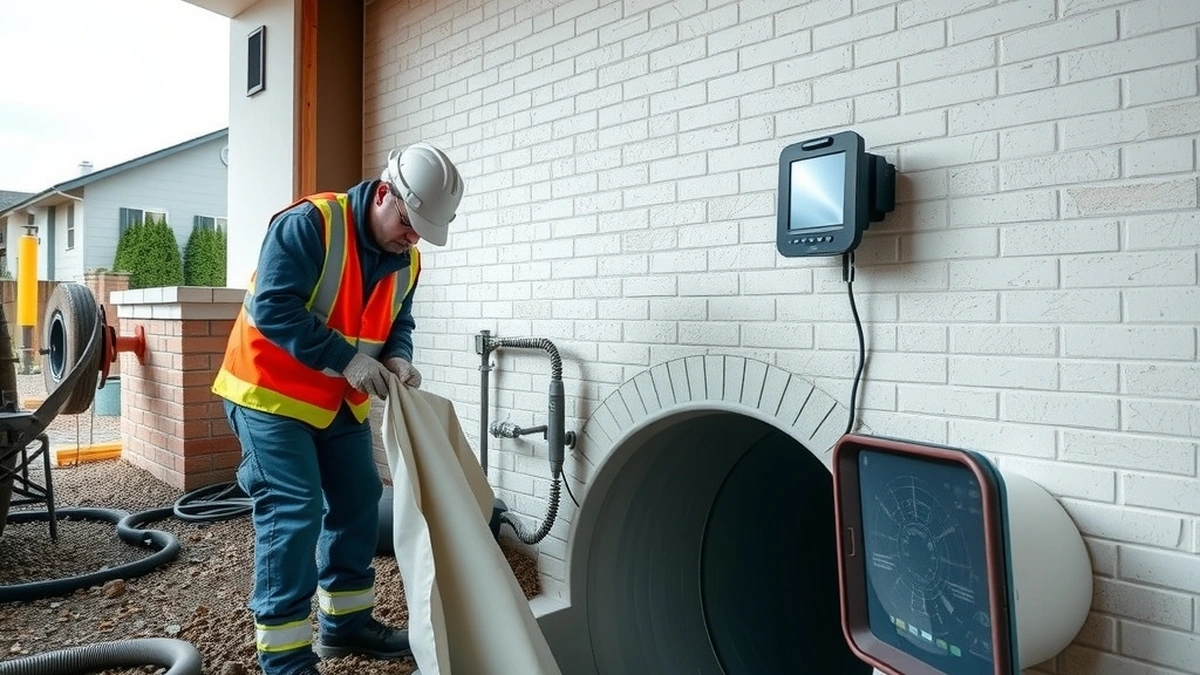
Trenchless lining is a repair method that pulls or pushes a resin-saturated tube into an existing sewer pipe and cures it against the pipe wall, leaving a new smooth bore inside the old host pipe. Nothing is excavated except at the cleanout and, sometimes, one access pit.
| Line item | Typical range | What it pays for |
|---|---|---|
| Camera inspection | $200–$500 | Locating defects, measuring footage, confirming the pipe is round |
| Hydro jetting | $300–$800 | Removing grease, roots, and scale so the liner can bond |
| Trenchless lining | $4,000–$12,000 | Liner, resin, crew, cure equipment, two access points |
| Spot repair, if only one defect exists | $1,500–$5,000 | Cutting out a short section instead of lining the run |
| Full replacement, for comparison | $5,000–$15,000 | New pipe along the whole run, open trench or pipe bursting |
Add it up on a mid-range job: $350 inspection plus $450 jetting plus $8,000 of lining is $8,800 before permits. Divide $8,800 by 55 feet and the job is $160 per foot. That per-foot figure is the only number worth comparing between contractors, because it normalizes for length.
Why the same pipe quotes at $5,200 and $11,400
Four variables explain almost every gap.
Footage is the first. A 30-foot run from the house to the main and a 90-foot run to a rear-lot main are different jobs at the same per-foot rate. Depth is the second: a liner installed through a basement cleanout needs no digging, while a line 8 feet down may need a shored pit, and pit work is billed by the hour.
Fittings are the third. Every wye, bend, and offset is a place where the liner has to be shaped, cut, or bridged. A straight run cures evenly. A run with four bends and two service connections takes longer, uses more resin, and needs a crew that has done it before.
Surface restoration is the fourth, and the reason lining exists. Cutting a concrete driveway costs a few thousand dollars on its own, and lining usually avoids the cut. When the access pit lands in a flower bed instead of a driveway, the restoration line on the quote drops to almost nothing.
The per-foot math, worked both ways
Per-foot pricing is not linear, and it is worth seeing why.
- $4,000 for 40 feet is $100 per foot.
- $12,000 for 40 feet is $300 per foot.
- $4,000 for 80 feet is $50 per foot.
- $12,000 for 80 feet is $150 per foot.
The same $4,000 to $12,000 envelope produces a per-foot spread of $50 to $300 depending on length. A quote of $9,000 on 40 feet ($225 per foot) and a quote of $9,000 on 75 feet ($120 per foot) are not the same value even though the total matches. Ask each contractor for footage measured from the camera, not from the property line.
Lining versus digging, in dollars
An $8,000 lining on a 55-foot line under a finished driveway is the whole bill plus a $350 inspection: $8,350. An $11,000 open-trench replacement on the same line is $11,000, plus a $400 inspection, plus $2,400 to saw, remove, and repour the driveway: $13,800. The gap is $5,450, and it is entirely made of restoration and surface work.
Reverse the conditions and the gap closes. On an 80-foot run through an open side yard with no concrete and no landscaping, replacement may quote at $9,000 while lining quotes at $9,500, because the liner material cost scales with footage and the digging cost does not. Lining is not automatically cheaper. It is cheaper where excavation and restoration are expensive, which describes most city lots and few rural ones.
Pipe condition decides whether the choice exists at all. A liner needs a host pipe that still holds its shape. A collapsed section, a back-pitched run, or a pipe that has lost more than a fraction of its round profile rules lining out, and the job becomes pipe bursting or open trench instead.
What the quote should itemize
A single total is not an estimate. Ask for these lines separately so two bids can be compared:
- Footage measured on camera, with the video file handed over
- Per-foot liner rate and the resin type specified
- Cleaning method and disposal of the spoil
- Access pit locations and who restores them
- Permit fees and who pulls the permit
- Service connections and whether they are reopened by cutter or by hand
- Post-cure camera inspection, included or billed later
- Warranty length, what voids it, and whether it transfers to a new owner
The post-cure inspection is the line most often missing. Without it, a wrinkle or a failed service connection is discovered by the homeowner months later, and the fix lands in the trenchless lining problems category rather than on the installer’s account.
What to do next
- Book the camera inspection at $200 to $500 and ask for the recording, not just a verbal summary.
- Have the line jetted at $300 to $800 before anyone measures for a liner, since roots and grease hide the true condition.
- Ask the contractor to state in writing that the pipe is a candidate for lining, and what would disqualify it.
- Collect three itemized quotes using the list above, including at least one open-trench bid for comparison.
- Compare total cost including permits and restoration, then compare warranty terms before signing.
The installation sequence explains what happens on the day, and whether sewer line repair is worth it covers the break-even math against waiting or selling. For the wider price picture across all repair types, start with sewer line repair cost.
Frequently asked questions
How much does trenchless lining cost?
Most US homes pay $4,000 to $12,000 for trenchless lining, plus $200 to $500 for a camera inspection and $300 to $800 for cleaning before the liner goes in.
Is trenchless lining cheaper than digging up the pipe?
Usually, when the line is short and the surface above it is expensive to restore. An $8,000 lining often beats an $11,000 replacement once a $2,400 driveway is added back.
How is trenchless lining priced?
Most crews price per linear foot of liner plus a mobilization charge, then add cleaning, permits, and restoration. Ask for the per-foot rate and the footage in writing.
Does trenchless lining cost more for a longer run?
Yes, but not in a straight line. The liner cost scales with footage while the crew, equipment, and setup charges stay roughly fixed, so the per-foot price falls on longer jobs.
What makes a lining quote jump above $12,000?
Deep access pits, offset joints that need grinding, multiple service connections, traffic control, and emergency scheduling all push a job past the typical band.
Is trenchless lining covered by homeowners insurance?
The liner itself is usually excluded as pipe maintenance. Resulting damage such as a sewage backup into the basement may be covered, and some policies sell a backup endorsement.
Sources
Some links are affiliate links.If you buy through them we may earn a commission at no extra cost to you. We do not accept payment for rankings. Read the full disclosure.